You've probably had this happen already. A consultant issues a revised drawing set by email, the contractor forwards part of it to site, someone works from the wrong revision, and two weeks later everyone starts arguing about who sent what and when. By that point, the problem isn't just communication. It's cost, delay, accountability, and a document trail that no one fully trusts.
That's why a letter of transmittal matters. On a large capital project, it isn't admin for admin's sake. It's the formal handover record that tells the next party exactly what is being issued, why it is being issued, and what they're expected to do with it. If you treat it like a casual cover email, you'll create ambiguity. If you treat it like a control point, you'll prevent a lot of rework.
New project engineers often focus on the attached drawing, report, submittal, or response. Experienced document controllers focus just as hard on the wrapper around it. The wrapper is what makes the issue traceable.
Table of Contents
- What a Letter of Transmittal Is and Why It Matters
- The Core Components of an Effective Transmittal
- Common Transmittal Variations in Construction
- Annotated Examples and Ready-to-Use Templates
- Modernising Transmittals with Digital Document Control
- Best Practices for Routing Compliance and Traceability
- Conclusion The Transmittal as a Project Control Tool
What a Letter of Transmittal Is and Why It Matters
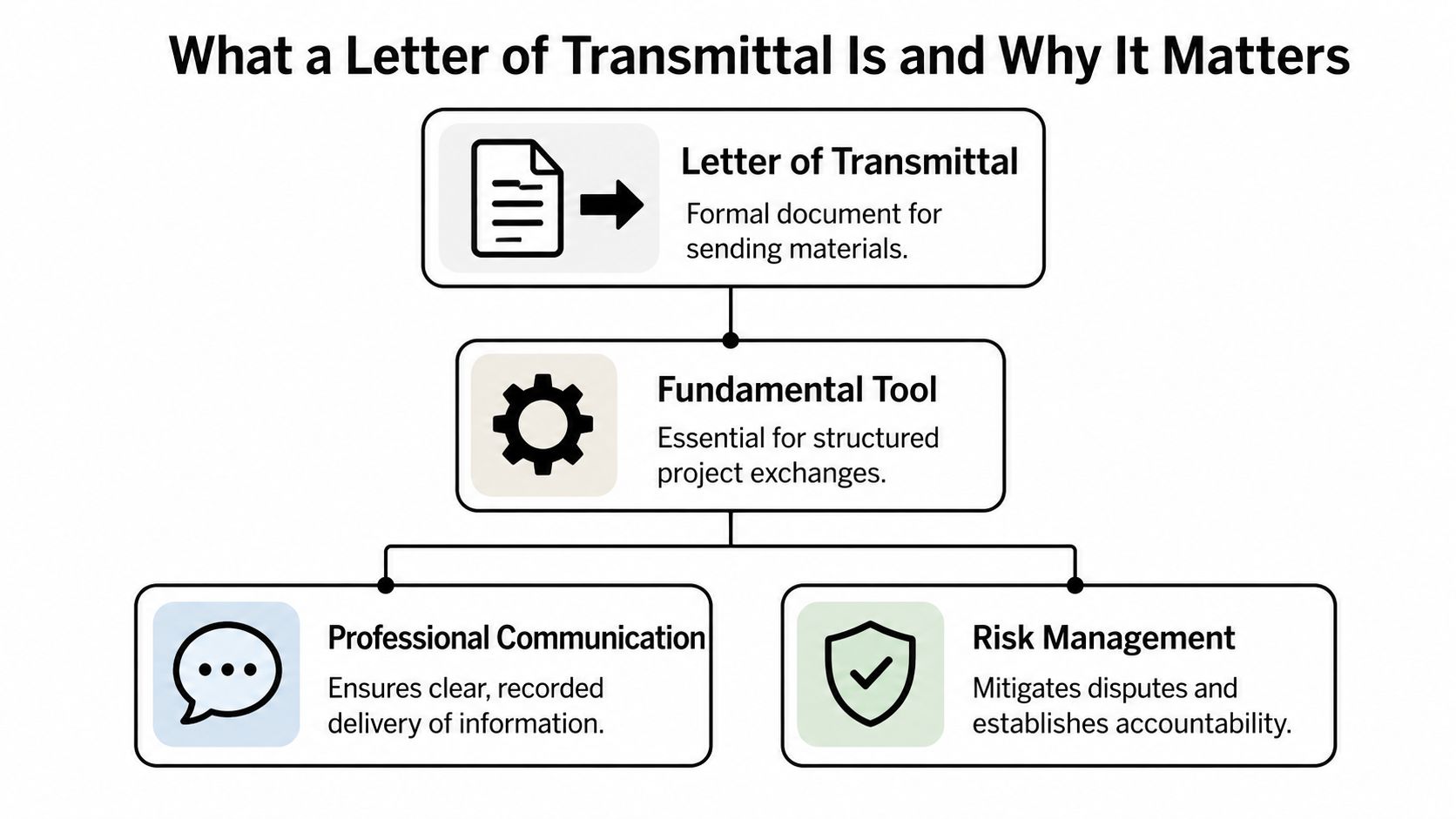
A letter of transmittal is the formal front page that sits before a report, drawing package, submittal, or other project document. In Australian-facing business writing guidance, it's treated as a short, formal business letter that explains what is enclosed, why it's being sent, and what the recipient should do next. That guidance also stresses that it should be brief, usually no more than one page, often organised into about three short paragraphs, with the date and recipient details in standard business-letter format, as outlined in Lumen Learning's letter of transmittal guidance.
In construction, I explain it to new engineers as the packing slip for project information. The attachment is the product. The transmittal is the formal record of delivery.
Why email alone doesn't hold up
An email can carry files, but it usually fails as a control document. Subject lines are inconsistent. Attachments get stripped out in forwarding. People reply on old threads. Someone saves the files locally and renames them. Six months later, the project team can't reconstruct the exchange cleanly.
A proper transmittal fixes that by answering the essential questions up front:
- What was sent
- Who sent it
- Who received it
- Why it was sent
- What action is required
Those five points sound basic. They're also what people argue about when a project goes off track.
Practical rule: If a third party can't understand the issue without opening the attachment, the transmittal is too thin.
The risk management function
The mistake beginners make is assuming the letter of transmittal is just etiquette. It isn't. It reduces ambiguity and creates an auditable trail. That matters when you're issuing design revisions, forwarding subcontractor submittals, responding to RFIs, or sending material for approval.
On live projects, the difference between “sent” and “formally transmitted” is significant. A casual message says communication happened. A controlled transmittal shows exactly what moved through the workflow.
Here's what works in practice:
- Use transmittals for formal exchanges: drawings, reports, calculations, submittals, manuals, and contractual correspondence.
- Keep the message lean: enough context to remove doubt, not a second report.
- Make action explicit: for review, for approval, for information, for construction, or for record.
- File the transmittal with the attached package: never separate the wrapper from the content.
What doesn't work is sending critical project information with no register, no revision reference, and no stated purpose. That's how teams end up building from superseded information while everyone thinks they're covered.
The Core Components of an Effective Transmittal
A good transmittal is short, but it's never vague. For formal reporting and project documentation, guidance from MIT aligns around a concise structure. It's typically one page and around three paragraphs. The opening identifies what is enclosed and why, the middle gives a brief overview only, and the close requests follow-up or offers contact details. The letter sits before the report as a separate page, as described in MIT's guidance on letters of transmittal.
That structure works well on construction projects because it keeps the communication fast while preserving the metadata that makes the package clear.
The non-negotiable fields
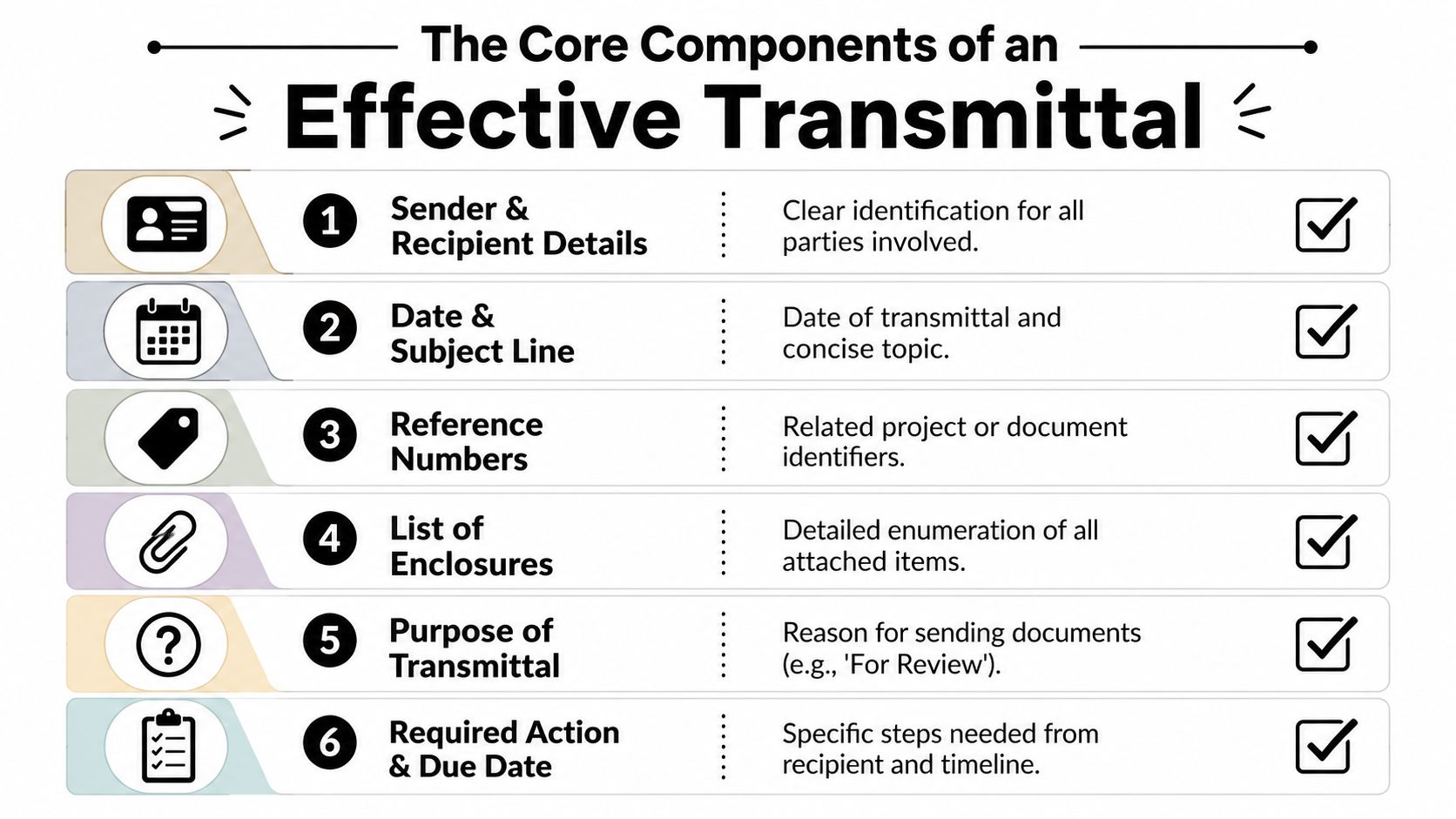
If any of these are missing, the transmittal is weaker than it should be.
| Component | What it needs to show | Why it matters |
|---|---|---|
| Sender and recipient details | Company, contact, role, and intended receiving party | Prevents misrouting and weak attribution |
| Date and subject | Issue date and a clear subject line | Anchors the record in time |
| Project identifiers | Project name, package number, contract reference, or document code | Connects the issue to the correct workflow |
| Document list | Exact title, document number, revision, and date of each enclosure | Supports version control |
| Purpose | For review, approval, information, construction, comment, or record | Tells the recipient how to treat the package |
| Action required | What response is expected and by whom | Stops the document from stalling in an inbox |
What the wording should do
The wording doesn't need to be clever. It needs to be exact.
A weak purpose line says: “Please see attached.”
A strong purpose line says: “Please find enclosed revised structural drawings issued for review.”
A weak action line says: “Let us know your thoughts.”
A strong action line says: “Please review and return comments through the submittal workflow.”
Keep the narrative short. The register carries the detail. The body text carries the intent.
Where new engineers go wrong
Most transmittal mistakes aren't formatting errors. They're control errors.
- They describe the package loosely: “latest drawings” is not a document list.
- They omit revision identifiers: that invites people to compare the wrong files.
- They bury the required action: recipients then treat an approval package as information only.
- They overload the letter: the transmittal becomes a mini-report and no one reads it properly.
A reliable mental checklist is simple. Can an auditor, contract administrator, or replacement team member understand the handover without guessing? If yes, the transmittal is doing its job.
Common Transmittal Variations in Construction
A generic template is fine for office training. It's not enough for project delivery. The content of a letter of transmittal should change with the use case. Discipline-specific practice shows that transmittals can accompany very different types of material, including regulatory submissions, technical reports, and signed-and-sealed drawing sets. That's why one universal template often fails in real workflows, as noted in this discussion of how transmittals vary by use case.
On a construction project, the shift in purpose changes what the transmittal needs to emphasise.
Tender submission versus shop drawing issue
A tender transmittal is formal and controlled. It usually emphasises completeness, submission identity, and the fact that the package forms part of a commercial or contractual process. The tone is restrained because the exchange may be scrutinised later.
A shop drawing transmittal is more operational. It needs to show the subcontractor, package reference, revision status, and required review path. The critical point is routing. Who reviews first, and what status can they assign?
Here's the practical comparison:
| Use case | Primary concern | What the transmittal should stress |
|---|---|---|
| Tender submission | Formal handover | Submission identity, enclosure list, recipient, timing |
| Shop drawing submittal | Review workflow | Revision status, discipline, approval route, required response |
| RFI response | Clarity and speed | RFI reference, linked documents, response purpose |
| Revised drawing issue | Version control | Superseded revision, new revision, issue purpose |
| Close-out package | Handover completeness | Final document set, receipt, record copy |
RFI responses and revised drawings
An RFI response transmittal should be quick to read. The recipient usually wants one thing answered. The transmittal should point directly to the RFI number, the attached response, and any revised drawing or sketch linked to it.
A revised drawing issue needs stronger version discipline. If you're sending Revision C and Revision B is already in circulation, the transmittal must remove doubt about what is current and what has been superseded. If it doesn't, site teams may keep both sets and use whichever one they find first.
Different packages need different wrappers. If the wording doesn't match the workflow, the record won't either.
External stakeholders and formal acceptance
Some transmittals are internal routing tools. Others are external handovers to clients, authorities, certifiers, or consultants. External issues usually need cleaner language, stronger references, and more disciplined enclosure lists because the receiving party isn't working inside your internal shorthand.
That's where rigid templates break down. A transmittal for a regulatory submission won't read like a subcontractor material submittal, and it shouldn't. Good document control adapts the format without compromising the core record.
Annotated Examples and Ready-to-Use Templates
Templates are useful, but examples are what make the logic stick. Below are two practical models. They're not fancy. They're built the way working teams can use them.

A point many teams miss is that a letter of transmittal isn't always just an introduction. In formal workflows, it can also function as a receipt or acknowledgement of delivery, sometimes with a client signature and even two copies, as discussed in Portland State material on cover letters and transmittal practice. That's especially relevant where chain-of-custody matters.
Example one revised architectural drawings for construction
Scenario: the architect is issuing a revised drawing set for construction after coordinated updates.
Subject: Transmittal of Revised Architectural Drawings Issued for Construction
Project: Central Plant Upgrade
To: Site Project Manager, Head Contractor
Date: [insert date]Please find enclosed the revised architectural drawing package issued for construction. This issue supersedes the previous architectural issue for the affected sheets and is being transmitted for use in the current construction sequence.
Enclosed documents:
- A-101 Ground Floor Plan Rev C dated [insert date]
- A-201 Reflected Ceiling Plan Rev C dated [insert date]
- A-501 Door Schedule Rev B dated [insert date]
Please distribute to relevant site and subcontractor teams and ensure superseded revisions are removed from active use. If any discrepancy is identified between this issue and previously received documents, advise the design team through the document control process.
Why this works:
- Clear issue purpose: issued for construction
- Specific enclosure register: each sheet listed individually
- Action required: distribute current set and remove superseded information
- Risk control language: directs discrepancies back through a formal path
Example two material submittal from a subcontractor
Scenario: the mechanical subcontractor is forwarding a product data package for review.
Subject: Material Submittal for Review
Project: Hospital Expansion Works
To: Design Consultant via Head Contractor
Date: [insert date]Please find enclosed the material submittal package for the nominated mechanical equipment item for consultant review. The package includes product data, technical literature, and supporting compliance information relevant to the specification requirement.
Enclosed documents:
- Submittal cover sheet [reference]
- Manufacturer product data [reference]
- Technical compliance statement [reference]
- Supporting certificates [reference]
Please review and return status through the approved submittal workflow. This transmittal does not authorise procurement or installation unless and until the package is returned with the required status.
What makes this stronger is the final line. It prevents a common failure. Teams assume submission equals approval.
Copy and paste template
[Your company letterhead]
Date: [insert date]
To: [recipient name, company, role]
From: [sender name, company, role]
Project: [project name and reference]
Subject: [clear transmittal subject]Please find enclosed the following documents for [review/approval/information/construction/record]. They are being transmitted in connection with [brief reason].
Enclosures
- [document title, number, revision, date]
- [document title, number, revision, date]
- [document title, number, revision, date]
Please [state required action]. If there are any discrepancies, missing items, or issues with the enclosed documents, please advise through the project document control process.
Regards,
[name]
[position]
[contact details]Acknowledgement of receipt
Received by: __________________
Name: _______________________
Date: ________________________
Modernising Transmittals with Digital Document Control
Manual transmittals break down for the same reason spreadsheets break down. Too many people touch them, too many copies exist, and nobody is fully sure which record is the authoritative one. On a complex project, the risk isn't only that a file gets lost. It's that the wrong file is treated as current.
In construction document control, a transmittal is more than a cover note. It's the auditable record of what was sent, to whom, and for what purpose, and it can be linked back to budgets, contracts, and change orders to preserve traceability across the project lifecycle. Mastt's construction guidance also recommends generating the transmittal with project details and a document list, then exporting and filing it with related records, as described in Mastt's explanation of construction transmittals.
What goes wrong in manual workflows
I've seen the same pattern repeatedly:
- Attachments drift: one recipient gets the complete package, another gets a partial forward.
- Registers split from files: the transmittal PDF sits in one folder, the drawings in another.
- Revisions become arguable: the team knows a later issue exists but can't prove who received it.
- Approval paths blur: comments come back by email, marked PDF, and phone call, all outside the record.
A manual system can still work. But only if the team is disciplined, the folder structure is rigid, and everyone follows the same naming and filing rules. On large projects, that level of discipline is hard to maintain over time.
What a digital system changes
A proper document management platform turns the transmittal from a document into a workflow event. That's the key shift.
Instead of drafting a letter separately, attaching files manually, sending them by email, and then trying to archive the evidence, the system logs the issue, links it to the exact files, records recipients, and preserves the issue history in one place. That creates a single source of truth.
The best transmittal record is the one no one has to reconstruct later.
That matters when someone asks any of these questions:
- Who issued this revision?
- Was it for review or for construction?
- Which subcontractors received it?
- What was attached at the time of issue?
- Was there any acknowledgement or response?
A digital workflow can answer those questions cleanly because the metadata, attachments, and routing history are tied together.
Here's a short product walk-through that shows how modern construction platforms approach this problem:
The practical standard to aim for
Whether your team uses a dedicated platform or a tightly managed common data environment, the standard is the same. Every formal issue should be searchable, attributable, and recoverable without relying on one person's inbox.
If your current process can't do that, your transmittals are administrative. They aren't yet project controls.
Best Practices for Routing Compliance and Traceability
Most transmittal failures happen after issue, not at issue. The document gets sent, but it doesn't move through the right path, doesn't return with a usable status, or doesn't stay linked to the record that explains it. That's where routing discipline matters.
A strong process combines document control, commercial awareness, and practical site behaviour. You're not just sending information. You're controlling how it enters the project.
Set routing rules before the pressure starts
Don't leave routing to individual judgement on a busy day. Define it in advance.
- Subcontractor submissions: route through the head contractor before consultant review if that's the agreed path.
- Consultant design issues: send to the controlled distribution list, not whoever asked for the file informally.
- Client-facing packages: check contractual addressees and any approval authority before issue.
- Superseding revisions: issue to every party holding the earlier revision, not only the party who requested the update.
Teams often fail here by taking shortcuts for speed. The shortcut then creates an off-register issue that no one can fully defend later.
Make version naming match the transmittal record
Your file naming and your transmittal register should tell the same story. If the transmittal says Drawing S-402 Rev D but the attached PDF has a different filename or an incomplete title, confusion starts immediately.
I tell engineers to treat naming as part of the contractual record, not a drafting preference.
| Control point | Good practice | Common failure |
|---|---|---|
| File naming | Matches title block and transmittal list | Local desktop rename before issue |
| Revision status | Visible in filename and register | Revision hidden inside the PDF only |
| Distribution | Controlled list by package type | Ad hoc forwarding |
| Return status | Captured in the same workflow | Approval sent separately by email |
If the filename, register, and title block don't align, someone will trust the wrong one.
Build an audit trail that survives personnel changes
Projects run for long periods. People leave, roles change, and external parties rotate. Your transmittal system has to survive that turnover.
Good habits help:
- Store the issued transmittal with the exact issued package. Don't keep them in separate informal folders.
- Capture the purpose clearly. “For review” and “for construction” cannot sit in the same grey area.
- Retain receipt or acknowledgement where required. This matters for formal handover and disputed delivery.
- Record superseded status visibly. Don't rely on teams to infer it.
- Keep comments and responses tied back to the originating issue. Detached review comments weaken the chain.
Use transmittals to support compliance, not just communication
On regulated projects, transmittals often become evidence. They help show that the right document was issued, through the right path, to the right party. That matters in audits, claims, quality reviews, and practical completion handover.
A project engineer usually sees the immediate task. Send the package. Get the review. Move on.
A document controller sees the longer horizon. If a dispute lands months later, the transmittal trail may be the cleanest record the project has.
Conclusion The Transmittal as a Project Control Tool
A letter of transmittal looks simple because it's short. That's exactly why people underestimate it. On construction projects, its value isn't in elegant wording. Its value is in control.
Used properly, the transmittal tells the receiving party what the package is, how it should be treated, and what happens next. More importantly, it leaves a record that can be checked later without guesswork. That's what protects the job when revisions overlap, approvals stall, or someone questions whether an issue was properly made.
The strongest teams don't treat transmittals as clerical output. They use them as part of a disciplined issue process. The document list is exact. The revision status is clear. The routing path is controlled. The resulting record is easy to retrieve and hard to dispute.
That approach saves time, but time saving is only part of it. The bigger win is reduced ambiguity. Fewer arguments about status. Fewer missed actions. Fewer situations where site, design, and commercial teams are each working from a different understanding of the same package.
Digital systems make that standard easier to maintain because they keep the files, metadata, routing, and history together. But the principle is older than the software. Clear communication, clean records, and traceable handover are what keep complex projects under control.
If you're a new project engineer, learn this early. The attachment may carry the technical content. The transmittal is what makes that content usable, defensible, and properly managed.
If you want a cleaner way to manage transmittals, revisions, approvals, and searchable project records in one place, Doclio gives construction teams a single source of truth across drawings and documents without relying on scattered inboxes and folder workarounds.