The crew has finished the work, the variation was directed on site, materials are in, and the payment claim goes out on Friday. By Monday, the due date has shifted, the superintendent wants more backup, and someone on the other side says the variation was never properly approved. Payroll still lands on time. Supplier accounts still fall due. Cash flow gets squeezed long before anyone uses the word dispute.
Security of payment laws matter because they give contractors and subcontractors a statutory path to recover progress payments. But on live projects, that path only works if the records underneath the claim hold up. Late payment is common in Australian construction. The businesses that recover faster usually are not the ones making the biggest noise. They are the ones with dated site records, clear variation instructions, valid service records, and a payment claim that matches the job history.
That is the part many teams miss. Security of payment is tied directly to day-to-day project administration.
If the contract notice was stored in one inbox, the site diary lives in a notebook, delivery dockets are in a ute, and the variation approval sits in a text message, the claim is exposed before adjudication even starts. A workable process is different. Daily records, correspondence, photos, approvals, and claim schedules need to be captured as the job runs, not rebuilt after payment is withheld.
Strong claims are built month by month. The law helps, but the paperwork wins.
Table of Contents
- The High Cost of Getting Paid Late in Construction
- What Security of Payment Laws Really Mean for You
- Your Toolkit for Enforcing Payment
- Practical Steps to Bulletproof Your Payment Claims
- How Digital Workflows Create an Ironclad Evidence Trail
- Your Security of Payment Compliance Checklist
The High Cost of Getting Paid Late in Construction
Friday afternoon. Payroll is due, a supplier is asking whether the next delivery should leave the yard, and the progress claim is still sitting with the client team because someone wants backup for a variation raised three weeks ago. That is how late payment hits a job in practice. It does not stay in the accounts inbox for long.
On site, the first signs are usually operational, not legal. Crews get shuffled to better-funded work. Suppliers stop extending favours on lead times. The project team spends its time chasing paperwork instead of closing out instructions, quantities, and approvals while the facts are still fresh.
Practical rule: Late payment is a project control problem before it becomes a legal dispute.
The actual cost shows up in places teams often underestimate. Margin gets eaten by financing pressure and rework in the paperwork. Bargaining position weakens because the party waiting on cash is more likely to accept discounts, defer entitlement, or stay quiet about a defective payment schedule just to keep money moving. Once that happens, the argument is no longer only about what was built. It is about what can still be proved.
Cash flow damage shows up on site first
When a project starts slipping financially, the warning signs are usually easy to spot:
- Supplier strain: Credit gets tighter, staged deliveries get harder to secure, and minor account issues turn into hold points.
- Labour pressure: Supervisors and subcontract crews get distracted when payment uncertainty starts affecting wages, overtime, or resourcing.
- Admin backlog: Site instructions, dockets, variation records, and daily reports stop being chased properly because the team is stuck reacting.
- Weak claims: Entitlements that may have been recoverable become harder to press because the supporting record is incomplete, late, or inconsistent.
That last point is the one many teams miss. Security of payment legislation can give a contractor or subcontractor a path to recover money quickly, but the claim still stands or falls on the documents behind it. If the site diary does not match the variation log, if the delivery records are incomplete, or if the instruction exists only in someone's memory, the payment claim is exposed before it even goes out.
This is why late payment and documentation discipline are tied together. The jobs that recover faster are usually not the jobs with the best arguments in theory. They are the jobs where the team can show, day by day, what work was done, who directed it, what records were issued, and when the other party received them.
What Security of Payment Laws Really Mean for You
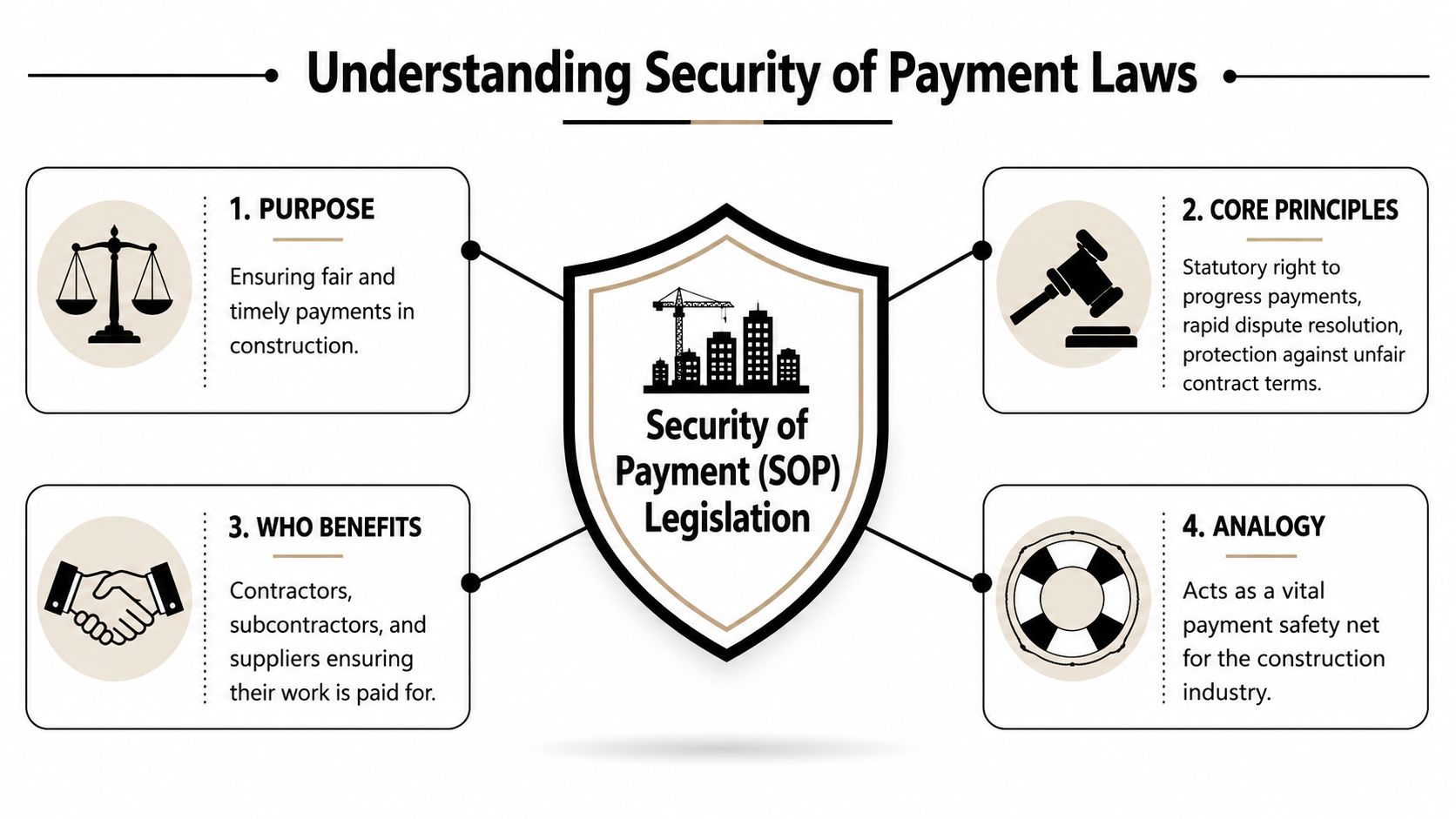
Security of payment works best when you treat it as a statutory safety net that sits beside your contract. Your subcontract, purchase order, or consultancy agreement still matters. But if payment is delayed or manipulated, the legislation gives you a separate path to pursue what's due.
Security of payment legislation was first introduced in New South Wales in 1999 and now exists in every Australian State and Territory, creating a statutory right to payment for construction work and invalidating unfair contract terms that hinder cash flow, as outlined in this guide to security of payment in the Australian construction industry.
A statutory right that sits beside the contract
Many payment fights aren't about whether work happened. Instead, they often revolve around one party's strategic advantage. One party knows the other side needs cash flow and uses delay, form defects, or contract wording to hold funds back.
Security of payment changes that balance. The legislation broadly gives eligible parties a right to make progress payment claims for construction work or related goods and services, and it imposes payment timeframes and dispute pathways. It also pushes back against terms that try to shut down that entitlement unfairly.
Think of it this way:
| Issue | Contract only | Contract plus security of payment |
|---|---|---|
| Late payment | You chase under contract terms | You may have a statutory right to claim |
| Unfair payment wording | You may be stuck arguing bargaining power | Some unfair barriers are overridden |
| Dispute timing | Can drag into long-form litigation or arbitration | A faster statutory pathway may be available |
That doesn't mean every claim succeeds. It means the other side doesn't control the field as easily.
Who these laws protect
These laws are built for the commercial reality of construction. They protect participants down the contract chain, including contractors, subcontractors, and suppliers performing work or supplying related goods and services. The wording and mechanics vary across jurisdictions, but the protective intent is consistent.
Security of payment exists because construction businesses can perform real value long before they receive real cash.
For project managers, contract administrators, and commercial leads, the practical meaning is straightforward. You need to know three things on every job:
- Which Act applies based on the project location.
- What the timing rules are for claims, schedules, and responses.
- What evidence is needed to prove the claim was validly made and validly served.
Teams often spend too much time debating legal theory and not enough time locking down process. Most failed claims aren't lost because the work had no value. They're weakened because someone can't clearly show what was done, when it was done, what supported the amount claimed, and how the claim moved through the required channel.
That's why security of payment is as much an operations discipline as a legal remedy.
Your Toolkit for Enforcing Payment
When payment starts to wobble, you need to know which lever to pull and when. Not every issue calls for adjudication. Not every claim should escalate immediately. Sometimes the strongest move is a clean, properly prepared progress claim that leaves the respondent with very little room to dispute form, timing, or scope.
The core tools work differently, and each has trade-offs.
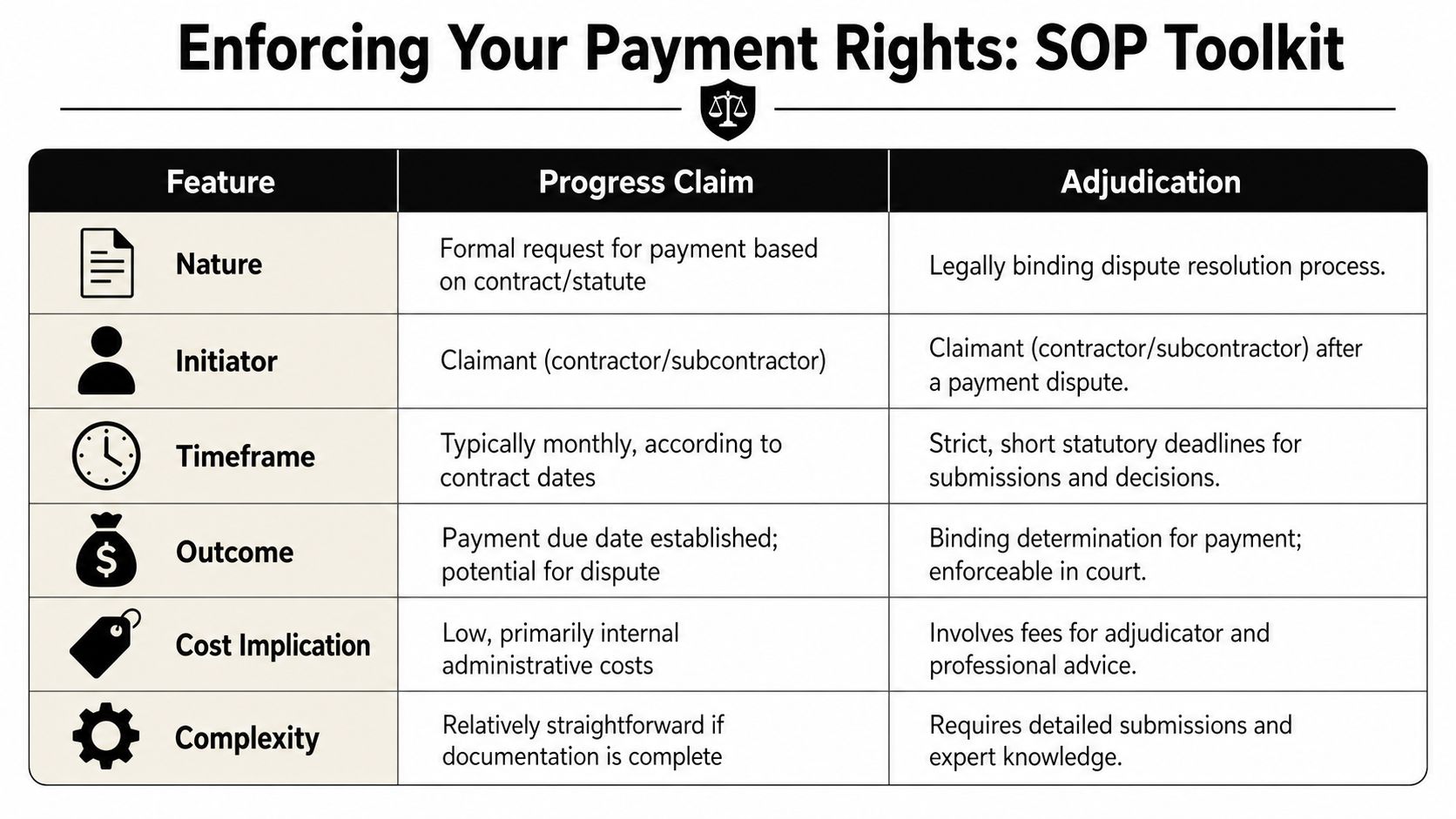
Progress claims and adjudication
A progress claim is your starting point. It's the formal claim for payment tied to the work completed, goods supplied, services provided, approved variations, or other contractual entitlements that are claimable under the applicable regime.
A strong progress claim does four jobs at once:
- States the amount claimed
- Identifies the work or basis of entitlement
- Complies with contract and statutory form requirements
- Creates a record that can support escalation if needed
An adjudication is different. It's the fast-track dispute mechanism used after a payment dispute has crystallised under the relevant legislation. It isn't casual correspondence with extra legal language. It's a structured process with short deadlines, detailed submissions, and a decision-maker who will usually work from the documents placed before them.
Here's the practical comparison:
| Tool | Best use case | Main strength | Main weakness |
|---|---|---|---|
| Progress claim | Routine payment cycle or first assertion of entitlement | Low cost, regular, forms the base record | Weak claims invite easy dispute |
| Adjudication | Payment has been withheld or disputed and speed matters | Faster determination path than full litigation | High pressure, document-heavy, poor prep gets exposed |
If your records are loose, adjudication can punish you quickly. If your records are organised, it can force a stalled payment issue into a defined process.
Retention regimes and other practical protections
Depending on the jurisdiction and project setup, you may also be dealing with retention money regimes, project trust structures, or other statutory account and fund-handling obligations. These aren't interchangeable with a payment claim, but they matter because withheld funds and poor fund administration can create a second layer of commercial risk.
From a project controls perspective, treat these as evidence-sensitive areas. Keep clear records of:
- Amounts withheld
- Contract basis for retention
- Dates of withholding and release
- Any notices or account records tied to the retention regime
Don't rely on someone in accounts to reconstruct this later from ledger notes. If a retention issue turns contentious, the commercial team will need project-side records that match the financial records.
What works and what usually fails
The most effective enforcement approach is rarely the most aggressive one. It's the one that is hardest to attack on process.
What works:
- Claims tied to identifiable work fronts
- Supporting records attached at the time of claim
- Variation evidence linked to instructions and pricing history
- Service records that show exactly when and how the claim was sent
- A consistent narrative across site diary, programme, correspondence, and claim documents
What fails:
- Backfilled records created after the dispute starts
- Loose variation language such as “as discussed on site”
- Competing versions of the same attachment
- Claims sent through the wrong channel
- Teams assuming merit will overcome non-compliance
Commercial lesson: If the other side can turn your payment claim into an argument about process, they've already improved their position.
One more practical distinction matters. Security of payment is not the same as payment security in the PCI sense. If your business also handles card-present or browser-based transactions, PCI-aligned controls require regular scanning, testing, wireless access point checks, and payment page tamper detection, as summarised in this PCI DSS overview. That's important for transaction security, but it won't rescue a construction claim that lacks approval history, service evidence, or document provenance.
For construction teams, the payment battle is usually won or lost in the project file.
Practical Steps to Bulletproof Your Payment Claims
Most payment claims don't fall over because the work wasn't done. They fall over because the entitlement can't be proved cleanly enough under pressure. For smaller subcontractors and suppliers in particular, security of payment is less about fraud controls and more about documented evidence, especially in a sector with persistent insolvency risk, as noted in this discussion of secure payments for your business.
At the contract stage
Before work starts, read the contract like someone who expects a payment dispute, not like someone eager to mobilise.
Check these items first:
- Reference dates and claim dates: Make sure the team knows exactly when claims can be made.
- Notice requirements: Variations, delay notices, and claim notices often have separate triggers.
- Service requirements: Email may be allowed, or it may not. Named recipients matter.
- Supporting document requirements: Some contracts require breakdowns, statutory declarations, or specific annexures.
A practical contract review meeting should include the PM, CA, and site lead. If only the commercial team understands the notice regime, site records will drift out of alignment within weeks.
The best time to prepare for adjudication is before the first toolbox talk, because that's when you can still shape the record-keeping habits that decide the dispute.
A few habits help immediately:
- Build a claim calendar for the project.
- Create variation numbering rules before the first instruction lands.
- Agree who can issue, approve, and receive formal notices.
- Lock a document naming standard that works across site and office.
During project execution
Most claims are strengthened or weakened by their practical execution. Daily administration sounds dull until the payment schedule arrives and the respondent says the work wasn't instructed, the variation wasn't approved, or the value can't be tracked.
The file you want is simple to use and hard to challenge.
Records that matter most
- Daily site records: Labour, plant, areas worked, weather impacts where relevant, and key events.
- Photographic evidence: Dated, identifiable, and linked to location or work package.
- Instructions: Emails, meeting minutes, RFIs, site directions, and marked-up drawings.
- Variations: Scope change, pricing basis, approval status, and any provisional direction to proceed.
- Delivery and supply records: Dockets, receipts, and confirmation of incorporation where needed.
- Communications trail: Who said what, when, and in response to which issue.
Not every record carries equal weight. A signed instruction or traceable approval usually beats a recollection in a meeting note. A dated photo linked to a drawing location is stronger than a folder of unnamed site images. A variation register that matches the claim line items is far more persuasive than a spreadsheet maintained only at month end.
What project teams should stop doing
Some habits create avoidable holes:
- Using personal phones with no upload discipline
- Approving changes verbally and assuming trust will carry the day
- Saving final files as “latest”, “latest2”, or “use this one”
- Leaving subcontract claims support in individual inboxes
- Treating site diaries as a compliance task instead of evidence
If the record lives in five inboxes, two WhatsApp threads, and a ute glovebox, it isn't a record. It's a future argument.
Before you serve a claim
Do a pre-issue check. Not a legal memo. A practical audit.
Ask these questions:
| Check | What to confirm |
|---|---|
| Entitlement | Does the contract and project record support the amount claimed? |
| Timing | Is the claim made on the correct date or within the applicable window? |
| Form | Does it meet the contractual and statutory requirements? |
| Support | Are all key attachments included and readable? |
| Service | Will it be served exactly as required? |
If one answer is shaky, fix it before service. Teams often rush the claim because they're focused on the due date. That's understandable, but a fast defective claim is usually worse than a carefully prepared one served correctly within time.
How Digital Workflows Create an Ironclad Evidence Trail
At 4:30 pm on claim day, the contract administrator asks for the instruction that supports a disputed variation. The site team has a photo on one phone, a markup in an email thread, a revised drawing in a downloads folder, and a supervisor who remembers the conversation but did not record it. That is how payment claims start to come apart. Not because the work was not done, but because the record is fragmented.
Security of payment law rewards teams that can prove sequence, authority, scope, and service with clean records. In practice, that means the job is won or lost long before adjudication. It is won in the daily habit of capturing instructions, tying them to the right drawing revision, recording who approved what, and keeping the claim pack consistent with the project record.
Why paper and email chains break down
The common failure is loss of continuity.
A PM gets an instruction by phone, confirms it by email, attaches a markup from a tablet, then receives a revised PDF through another thread. Site builds from version B. Commercial prices version A. The claim goes out with version C because that is what sat in the folder at month end. Once authority, scope, or timing is challenged, the team is arguing about record quality instead of payment entitlement.
Digital workflows help only when they preserve context, not just files. The system needs to show where a document came from, who touched it, what changed, and what record supports the claim line item. If it cannot do that, it is a storage tool, not an evidence system.
A workable setup should support:
- Version control for drawings and claim documents
- Structured approval paths for variations and site instructions
- Time-stamped activity history
- Searchable communications tied to the relevant record
- Controlled sharing with consultants, principals, and subcontractors
- Clear links between claim items, source documents, and completion evidence
A claim is easier to enforce when each attachment has a visible origin, a revision history, and a record of who issued or approved it.
Data discipline matters too. Keep claim evidence in the systems your team controls and can audit. Do not spread key records across personal devices, chat apps, shared drives, and inboxes unless you are prepared to explain the gaps later.
What a defensible digital record looks like
A defensible record lets the team answer dispute questions fast and with documents that line up:
- What was instructed?
- Which drawing revision applied at the time?
- When was the variation priced and submitted?
- Who approved it, or who received the request for approval?
- What evidence shows the work was done?
- Which exact documents were served with the claim?
Construction document control platforms can support that standard if they centralise drawings, registers, approvals, and field records in one controlled workflow. Doclio, for example, includes versioned drawings, linked documents, structured approvals, and an AI Assistant that can help locate project records and compare plan changes. Used properly, that kind of setup does not replace legal advice. It gives the team a cleaner evidence trail from instruction to execution to claim.
The trade-off is simple. Digital systems demand discipline up front. People need to upload records on time, use the right workflows, and stop treating email as the master file. But that effort is minor compared with the cost of rebuilding a claim from scraps after a dispute starts.
Build the evidence trail while the work is happening. Reconstruction after relationships deteriorate is slow, expensive, and often incomplete.
Your Security of Payment Compliance Checklist
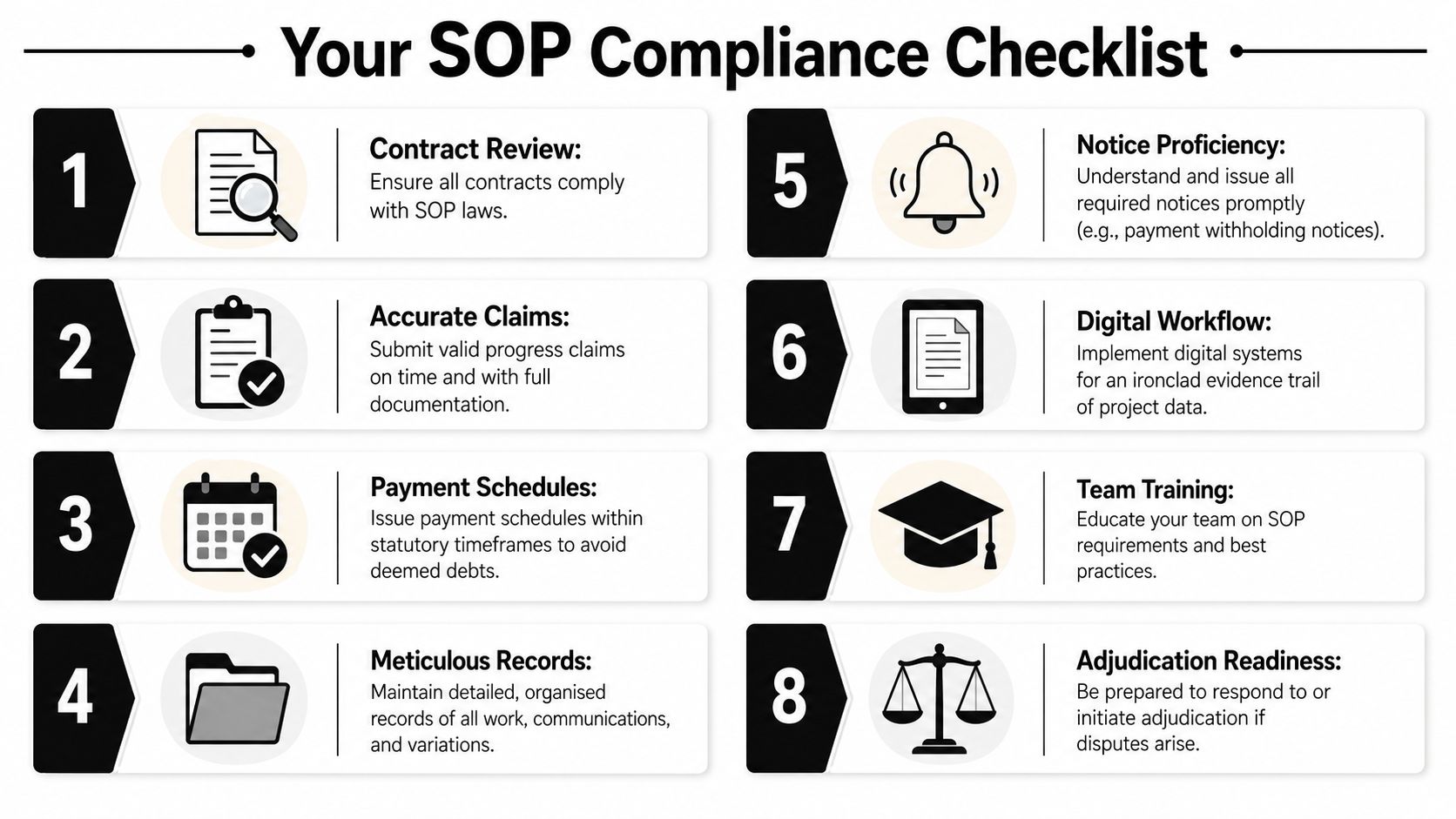
A payment claim usually fails long before adjudication. It fails on site, in the contract review, in the way instructions are recorded, or in the scramble to pull attachments together at the end of the month. Teams that get paid consistently do the routine work early and do it the same way every time.
Before the project starts
- Review the contract carefully: Confirm claim dates, notice periods, service requirements, and required supporting documents.
- Map the governing legislation: Identify which jurisdiction's security of payment regime applies.
- Assign formal responsibilities: Decide who issues notices, who maintains registers, and who signs off claim support.
- Set up the record system: Use one controlled workflow for drawings, instructions, variations, and claim attachments.
During each payment cycle
- Update site records daily: Keep labour, plant, progress, and event records current.
- Capture variation evidence immediately: Link instruction, scope change, pricing, and approval status.
- Check version integrity: Make sure the documents attached to the claim are the current and correct ones.
- Serve claims properly: Use the required channel, recipient, and timing every time.
If a dispute arises
- Freeze the evidence set: Preserve the exact documents, communications, and versions relevant to the claim.
- Build a chronology: Put events, instructions, submissions, and responses in date order.
- Match every amount to proof: Each line item should point to a document trail.
- Act quickly on statutory deadlines: Delay is often more damaging than the original underpayment.
Security of payment laws reward disciplined contract administration. The parties with the best records are usually the parties in the strongest position. If your team can show what changed, when it changed, who received it, and how the amount was calculated, the claim is harder to dismiss and easier to enforce.
That is the day-to-day link many contractors miss. The legal right to claim only gets you so far. The outcome often turns on whether your project documentation is organised, current, and traceable from site instruction through to formal service.
If your projects still rely on inboxes, shared drives, and scattered PDFs to support payment claims, Doclio is one practical document control option. It centralises drawings, documents, approvals, and field collaboration so the team can maintain a cleaner evidence trail from instruction through to claim.